This post contains affiliate links. Please see our disclosure policy.
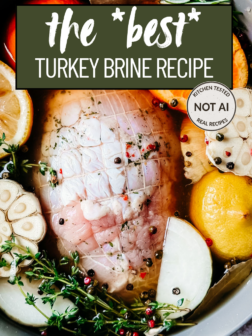
Citrus, herbs, and a good long soak—this is the best turkey brine recipe and the reason your turkey comes out tender and juicy every time, no fuss, no fail. Once you make it, you won’t roast a bird without it. Great for the holidays!
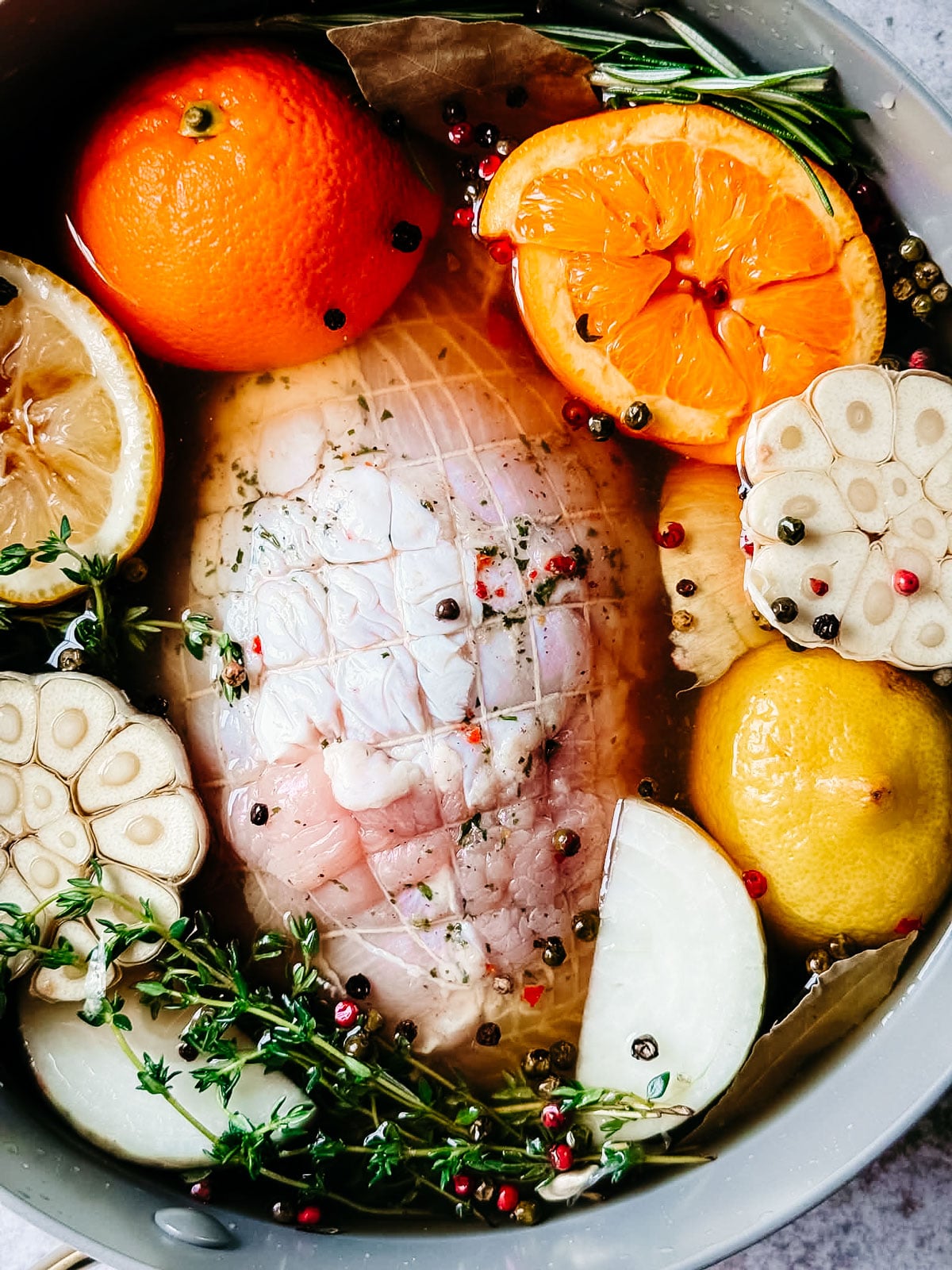
I can promise you that a good turkey brine is the single best insurance policy for a Thanksgiving turkey. Here’s the science: salt water slowly breaks down the meat’s protein strands, tenderizing it while boosting moisture retention and flavor absorption. So even if the bird spends a few extra minutes in the oven, it comes out juicy, not dry. As a bonus, the drippings left behind make a deeply savory base for gravy. Suddenly the turkey isn’t just an obligation next to the sides—it’s the thing everyone’s actually excited about. (Imagine!)
Ready to put this brine to work? Try it with my oven-roasted turkey breast or the air fryer turkey breast for something faster (fantastic for smaller families). Brining something smaller? Here’s how to brine chicken breasts.
Table of Contents
Why Brine Turkey?
- It’s forgiving: run a few minutes over on roasting time, and the turkey stays juicy anyway. The brine builds in a margin for error, so there’s no more agonizing over dry breast meat.
- The results speak for themselves: people don’t just like this turkey. They tell me it’s ruined every other turkey for them. The comments section will back me up.
- The gravy practically makes itself: a brined turkey yields deeply savory drippings, so you end up with the best pan gravy of your life with zero extra work.
- There’s no skill involved: dissolve, cool, dunk, wait. That’s the whole process.
Ingredients at a Glance
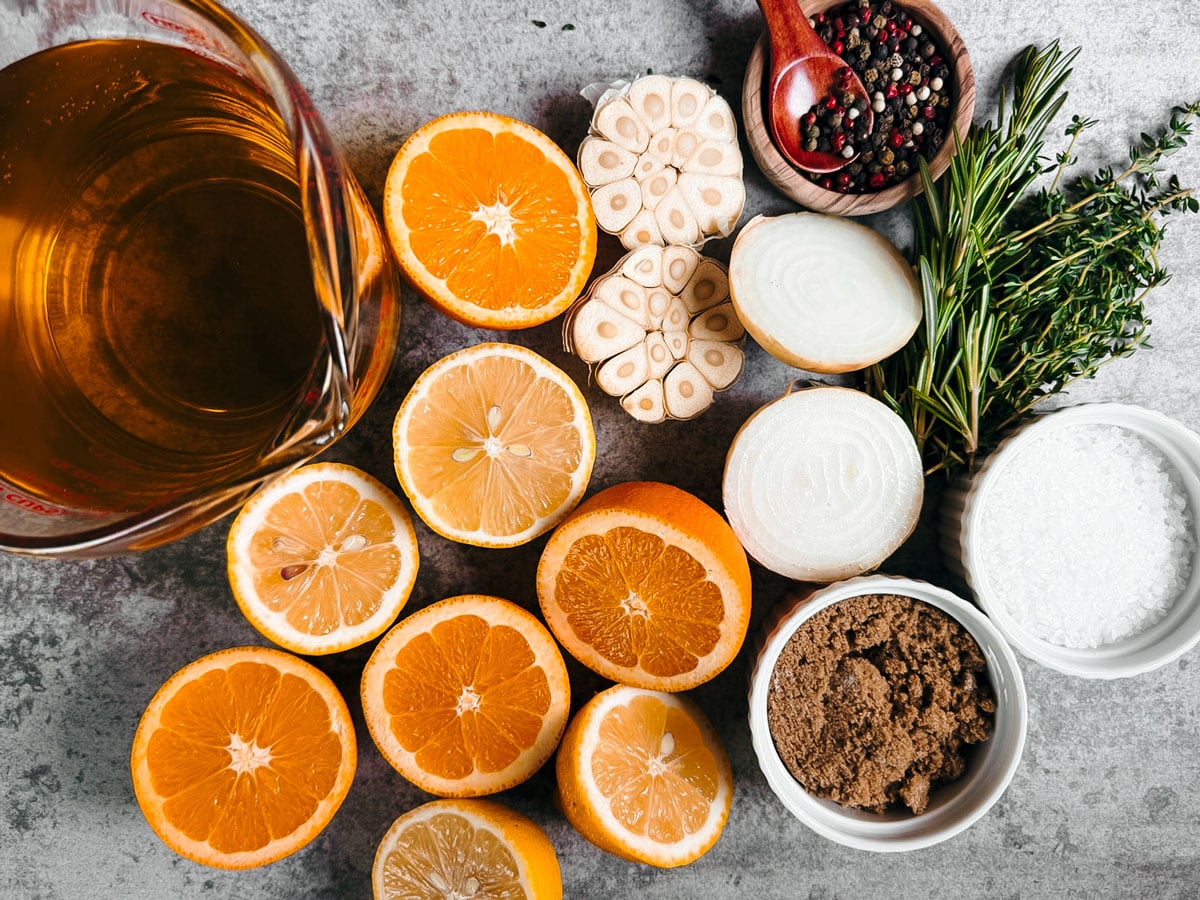
A quick look at some of the essentials before we dive into the recipe.
- Apple cider (juice, NOT vinegar): my go-to liquid base for turkey brine because it’s SO flavorful. You can also use apple juice, or just plain water.
- Citrus fruit: oranges and lemons brighten the brine’s flavor.
- Fresh herbs & spices: one or two of those pre-packaged bouquets of poultry herbs (fresh thyme, rosemary, sage, and parsley) will do the trick.
- Coarse kosher salt: Morton’s is my go-to and is easy to find here in the US. Don’t use table salt because it’s iodized and will give your turkey an off-taste—almost metallic.
- Brown sugar: takes the edge off the salt, helps the surface caramelize into a deep, browned crust, and adds a little depth from the molasses.
Useful Equipment
- A brining container: the size depends on what you’re brining. A large stock pot works fine for a breast. For a whole turkey, you’ll need something deeper—a brining bucket or a brining bag.
- Liners: if you’re using a brining bucket, bucket liners make cleanup much easier.
- Hand protection: food-safe gloves are worth having on hand when you’re working with raw meat.
- Disinfectant: clean your sink and the surrounding area thoroughly once you’re done—I rely on this surface cleaner.
- Meat thermometer: roast the turkey until a meat thermometer reads 160°F in the thickest part of the breast and the innermost parts of the thigh and wing.
Turkey Brine Formula: Whole Bird vs Breast
For a Whole Bird
- Time: 12-24 hours
- Salt & liquid: 1/2 cup Morton Coarse Kosher salt per gallon of liquid.
For a Turkey Breast
- Time: 3-8 hours
- Salt & liquid: 1 cup of Morton Coarse Kosher Salt per gallon of liquid.
Why More Salt for a Shorter Brine?
Salt moves into meat by diffusion, so the stronger the brine, the faster it penetrates. With only 4-5 hours, you need that higher concentration to get enough salt in before time’s up. Over 14 hours, though, that same strength would oversalt the meat, so you dilute it, giving the salt more time to spread evenly without turning the texture spongy or the flavor too aggressive.
Step-by-Step: How to Brine a Turkey
Step 1: Make the Brine Base
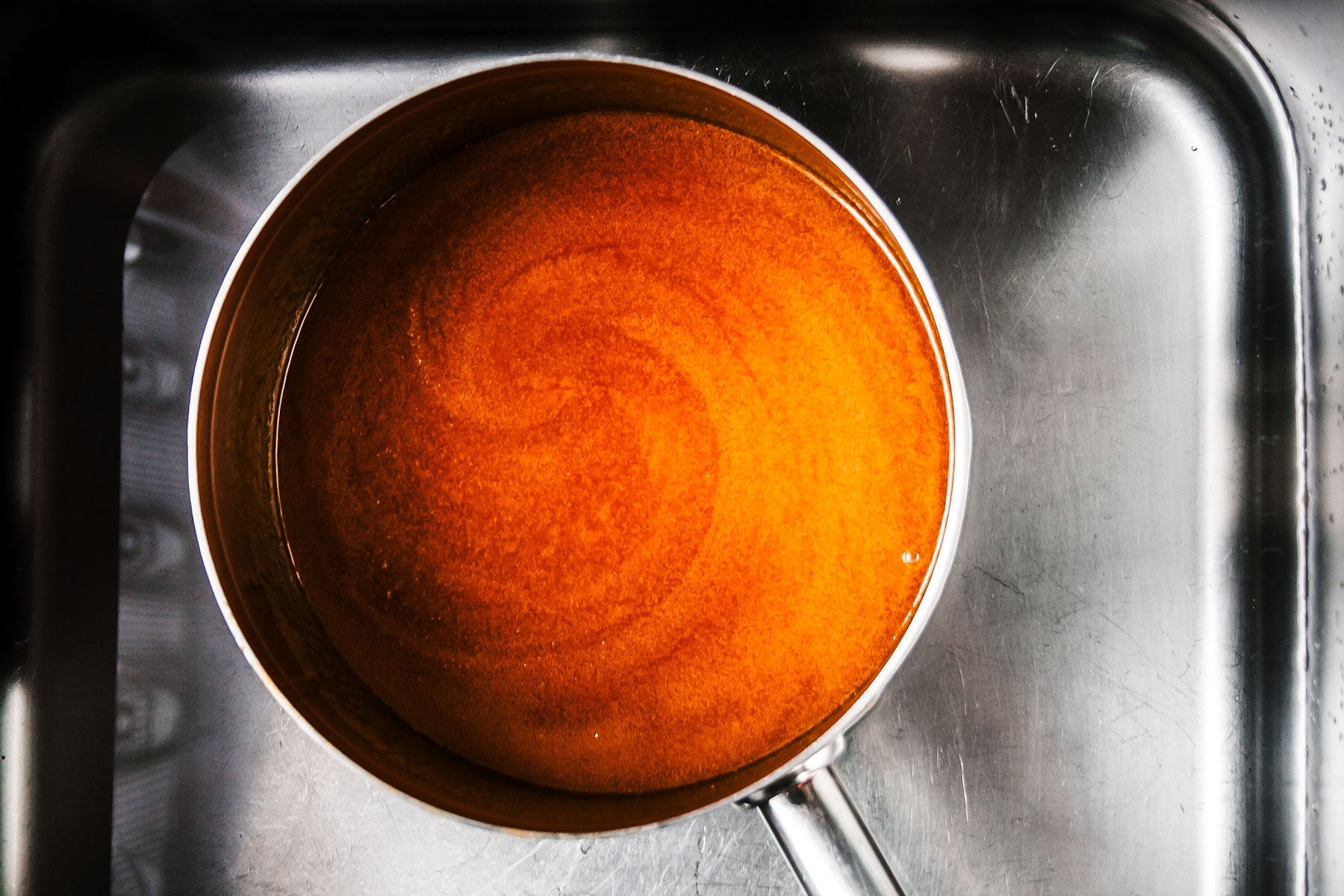
Pour 8 cups of cider or water into a large saucepan. Add the salt and sugar, and bring to a boil. Once boiling, reduce to a simmer and let it go, stirring occasionally, until the salt and sugar dissolve. When done, set it aside and let the liquid cool completely. (You can speed this up by adding ice.)
Step 2: Add the Aromatics/Flavors
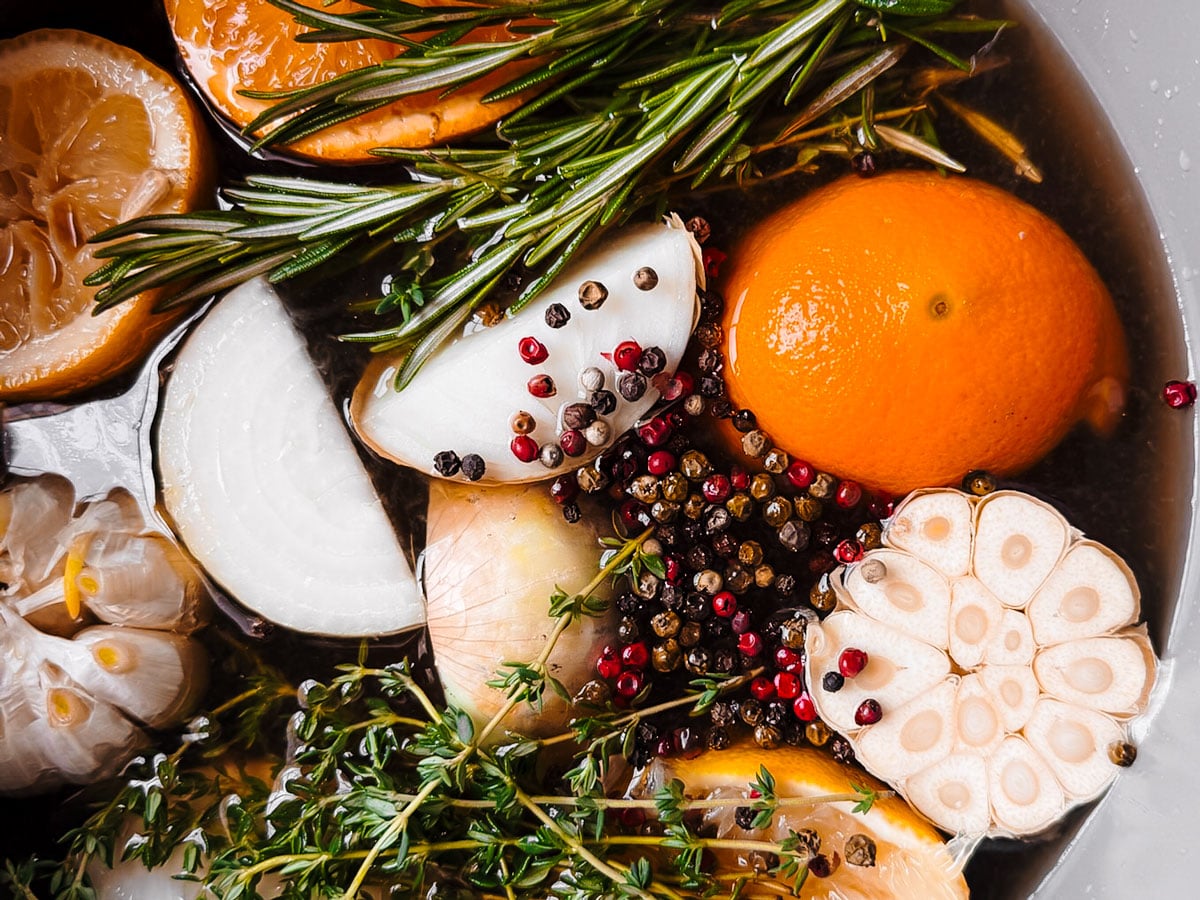
Transfer the cooled brine to a brining container, then add the remaining cider or water, along with garlic cloves, herbs, and peppercorns. Squeeze the juice from the oranges and lemons into the pot (don’t worry about the pits), then add the squeezed oranges and lemons to the pot as well.
Step 3: Brine the Turkey
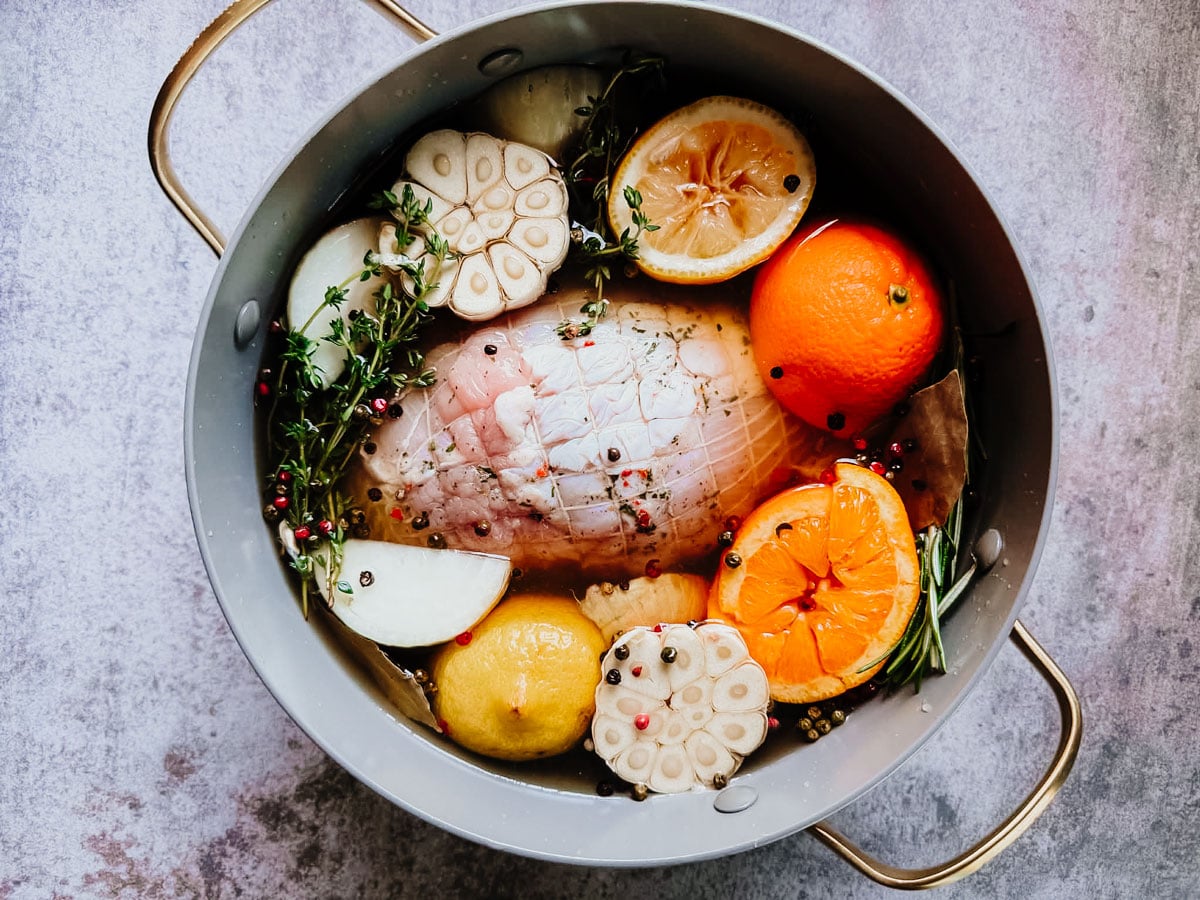
Slowly and carefully submerge the turkey in the brine (careful, the liquid level will rise). Cover and refrigerate for an hour per pound.
Step 4: Rinse the Turkey
When the brining time is up, carefully transfer the turkey to the sink. (I line mine with plastic grocery bags to try and keep things more sanitary. You could also use plastic wrap.) Carefully but thoroughly rinse the turkey with low water pressure to avoid splashback. This will rinse off excess salt. If you skip rinsing, you will end up with a too-salty turkey.
Step 5: Cook the Turkey
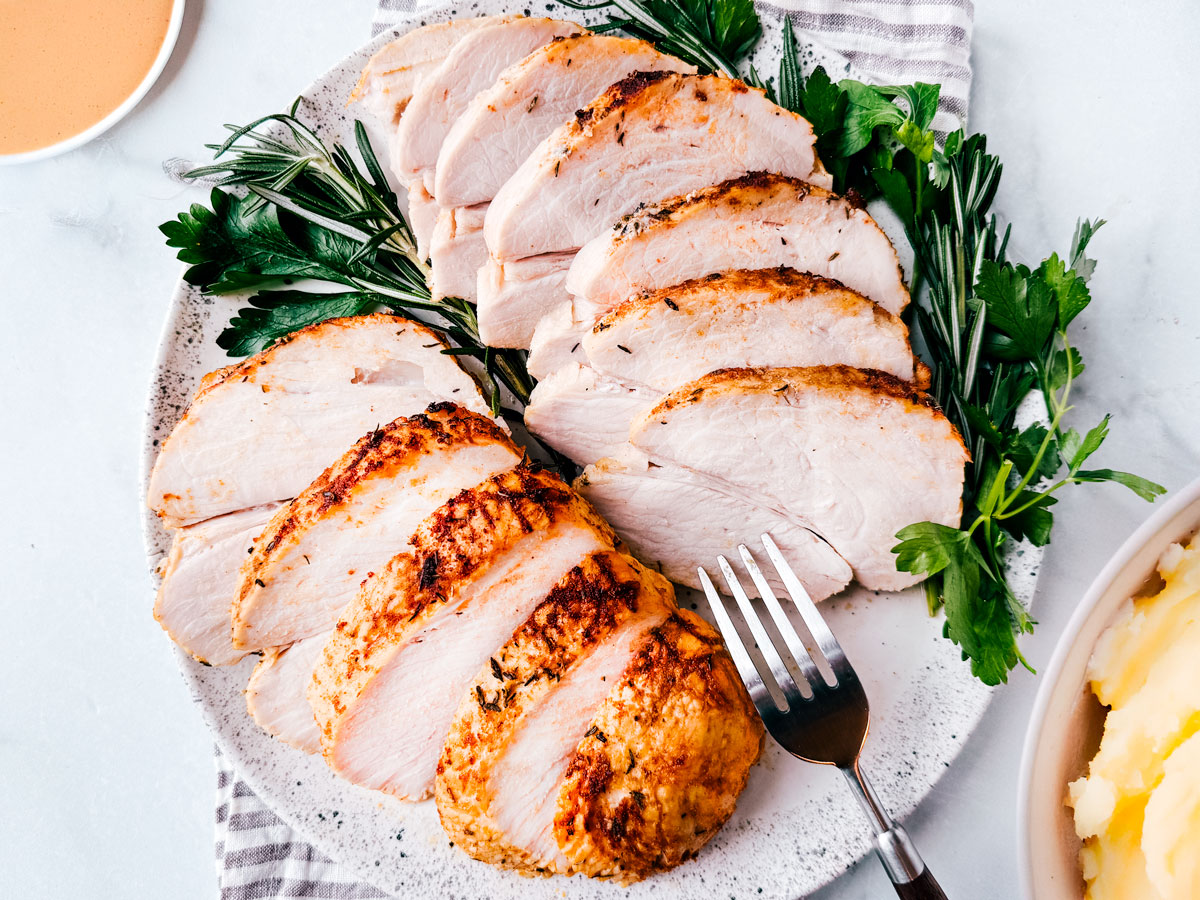
After the rinse, pat the turkey dry with paper towels and transfer it to a cooking vessel, like a roasting pan or casserole dish. You can now prepare it and season it with a rub or an under-the-skin compound butter. This brining process works great if you’re planning on a smoked turkey, too!
Tips From My Kitchen
I make mistakes so that you don’t have to! Here are some things I’ve learned while testing this recipe…
- Choose food-grade plastic, glass, or stainless steel for a brining container: acid and salt react with aluminum, copper, and cast iron, giving the meat a metallic taste.
- If you only have fine salt: because fine salt packs more tightly into a measuring cup than coarse kosher salt, only use 3/4 cup to avoid more sodium than the recipe intends.
- Rinse the turkey after brining: this rids of surface salt, sugar, or loose herbs and peppercorns that could burn or leave the skin too salty.
- Pat the turkey dry and set it in the fridge, uncovered, for a few hours, up to overnight: wet or damp meat steams instead of searing. Letting the exterior dry out ensures a nice crisp exterior.
Substitutions
- Different liquid bases: I love using apple cider for flavor, but you can use water, beer, wine, broth, or orange juice, depending on the flavor profile you’re after.
- Flavors: In addition to herbs and citrus, you could throw in apples, onions, and celery, too.
- White sugar: You can use this instead of brown, but I highly recommend brown sugar for the deeper flavor.
Make Ahead & Storage Tips
Make it in advance: you can store unused brine made with salt and water alone in the refrigerator indefinitely. With apple cider, herbs, or aromatics like garlic and citrus, it will last up to two weeks. Discard used turkey brine—you cannot reuse it.
Use Turkey Brine With These Recipes
Turkey: Air Fryer Turkey Breast, Oven-Roasted Turkey Breast
Chicken: Roasted Spatchcocked Chicken. With chicken breasts, you can use a very unfussy method. Check out my tutorial on how to brine chicken breasts.
Troubleshooting
This usually means there isn’t enough liquid to fully dissolve the salt during the simmer in step 1. Bring at least 8 cups of liquid to a simmer rather than 4—liquid can only hold so much dissolved material before it hits its limit and stops absorbing more.
A few likely culprits: the meat was labeled “enhanced,” “self-basting,” or “kosher,” which means it already contains added sodium. Brining it on top of that pushes it too far. It’s also possible the brine sat too long (past 24 to 48 hours) or the surface salt wasn’t rinsed off before cooking.
You can! Make sure your brine is cold, so refrigerate it before adding the turkey. This is a great way to thaw and brine your turkey in one shot to save time.
Best Turkey Brine Recipe
Ingredients
- 1 14 lb turkey, giblets and neck removed
- 2 gallons liquid (apple cider is my preferred choice; water also works)
- 1 cup coarse kosher salt or good quality coarse sea salt, See tips below on measuring this
- 1 cup brown sugar
- 8 cloves of garlic, smashed
- 2 oranges, juiced and halved
- 2 lemons, juiced and halved
- 4 tablespoon peppercorns
- 4 bay leaves
- Handful of fresh herbs like rosemary, thyme, sage, and parsley.
Instructions
- Transfer 8 cups of cider or water to a saucepan.
- Add the salt and sugar to the saucepan, bring to a boil, then lower to a simmer. Simmer, stirring occasionally, until the salt and sugar dissolve. When done, set it aside and let the liquid cool completely. (You can speed this up by adding ice.)
- Place your brining container into the sink. Pour the cooled brine into your brining container, then add the remaining cider. Squeeze the juice from the oranges and lemons into the brine before adding the fruits themselves to the brine. Finally, add the other aromatics, such as the garlic, onions, fresh herbs, and peppercorns.
- Slowly and carefully submerge the turkey in the brine (the liquid level will rise; you can pour off excess into the sink if needed).
- Cover and refrigerate (for a large, whole turkey, 12-24 hours; for a turkey breast, 3-8 hours).
- When the brining time is up, carefully transfer the turkey to the sink (see notes). Carefully remove the turkey from the container and rinse it thoroughly under low water pressure to avoid splashback. This will rinse off excess salt. If you skip rinsing, your turkey will be too salty.
- After the rinse, pat the turkey dry with paper towels.
If Air-Drying the Turkey
- Set the turkey onto a platter or large plate and put it in the fridge, uncovered, for 12-24 hours.
If Cooking Immediately
- Transfer the turkey to a cooking vessel. Now season it and prepare it as you normally would.


If I don’t have coarse kosher or sea salt, can I use regular iodized salt? Or coarse Himalayan? If I use one of those, do I need to adjust the amount?
Hi Amy, I would halve the salt amount if using fine table salt. Coarse himalayan should be fine at the ratio given. Let me know how it turns out!
I made my brine last night and it is cooling in the fridge to use for the turkey tomorrow. I did boil my items such as cinnamon, star anise, orange peels and such. I hope that does not ruin anything.
What does the apple cider do? I’m worried that all water would lose some flavor, but I don’t have the cider on hand. Is there a good substitute?
Hi Terri! Apple cider is extra flavor, but you can use water! No worries. Brine in general is all about the salt penetrating the meat and creating a tender and juicy texture. I throw everything else in for extra flavor. Let me know how it goes!
Thank you. Will do.
What seasonings did u use and the amoutn
Sometimes I use poultry seasoning, or sometimes I use an herb blend. For my air fryer turkey breast recipe I have a blend I whip up myself that includes the following:
1/2 tsp ground dried sage
1/2 tsp dried thyme
1/2 tsp sea salt
1/2 tsp cracked black pepper
1/4 tsp dried marjoram
1/4 tsp dried rosemary
1/8 tsp ground nutmeg
You might want to double up the measurements for a larger bird, though. I hope this helps! Let me know how it goes :)
Silly question but are you not boiling the garlic, spices, and citrus with the brine? You boil the salted water and then add the spices after once it’s cooled? Thanks!
That’s right, no boiling the other stuff. The simmer is simply to dissolve the sugar and salt into the brine and I do it with a smaller amount of the liquid so it cools off more quickly. I hope that makes sense!
When I brine I boil the salt and sugar in much less water, shortens the cooling time by adding the rest of the liquid cold, I use this brine and its awesome, I do cut the salt, and I use Crystal brand, less salty. Happy Thanksgiving all!
Hi, sorry if this is a dumb question, but this is my first year doing a turkey myself. What would you recommend brining the turkey in?
It depends on the size of the turkey. There are actual brining bags like this one here. Some people use a brining container or bucket like this. If it’s just a turkey breast, you could get away with a large stock pot. I hope this helps! Let me know how it goes.
I usually cook a large turkey like 18 pounds and don’t have a refirgerator large enough to accomodate it. I have put it in an ice chest and added ice to the brine so it stays cold enough but still gets the benefit of the brine. I make to brine a little stronger so it won’t be too diluted with the melting ice. I also check and add ice to maintain refrigerator temperature.
I’m glad this works for you, Carla. Thanks for posting this as it could help someone else in a similar situation!
I’ve done this, but put the turkey in a bag with the brine and the pit that whole thing in the ice box with lots of ice, that way the brine is not dilated by the ice melting.
What do you season the turkey with after wet brining? It says low salt but any other suggestions? And (last question) should I season when I’m
Letting it dry in my fridge or wait until
Cooking? This is my first time doing a wet brine.
Hi Stephanie! After brining you can basically proceed as usual with however you like to season your turkey. Sometimes I use poultry seasoning; sometimes I use an herb blend. Here’s what I use on my air fryer turkey breast recipe, which is always a hit:
1/2 tsp ground dried sage
1/2 tsp dried thyme
1/2 tsp sea salt
1/2 tsp cracked black pepper
1/4 tsp dried marjoram
1/4 tsp dried rosemary
1/8 tsp ground nutmeg
Though with a larger bird, you might want to double up the measurements. Let me know how it goes :)
Sounds weird but due to the size of bird I generally have I often use a food safe 5 gallon bucket with a lid and then pack ice around the bucket making sure that it is always fully covered.
You say that you need to boil the water/cider long enough to dissolve the sugar and salt. But how long does it take to do this? I brought 2 cups of water, 2 cups of apple cider, 2 cups of course kosher salt, and 1 cup of brown sugar to a boil. I reduced to a simmer, and stirred at simmer for over 45 minutes, but there’s still a lot of salt in the pan. I even had to add more boiling water to the mix because it was getting so low. How long does this usually take?
Hi Mike! This shouldn’t take 45 mins at all. At this point I’d say you can just go with what you have—should be salty enough! Let me know how it goes.
Looks delicious. Can I replace the orange slices with orange juice?
Hi Haneen! You could definitely add some orange juice instead.
Hi what would the ratios be for a 9lb bone in turkey breast?
Thanks
Hi Alex! You could just halve this recipe. Make sure the bird is completely covered in brine though. If that means adding a little extra cider or water in order to fully submerge the bird, that’s fine. This always depends on what kind of vessel you’re using to keep your turkey in. Good luck! Let me know how it goes :)
This might be a dumb question. But how would I do the recipe if I am brining 2, 6lb turkey breasts?
Not dumb at all! Use the recipe as is and if you can, brine the breasts in the same container (if you’re using a large brining bucket). Another option is to brine them separately and in that case, just divide the brine among them. The important thing is to ensure they are fully submerged/covered so make sure you have enough liquid. If you need to add a little extra cider/water just to make sure the birds are covered, that’s totally fine. Good luck and let me know how it goes, ok? :)
I have a 22 pound turkey. How do you suggest I brine with your recipe? Thank you!
Hi Tiffany! Stick with the recipe as is and just make sure that the whole bird if covered in brine. If necessary, add more liquid, but you should be fine otherwise. Let me know how it goes!